Guidelines | Wytyczne
Advanced Practice Nursing in the field of wound prevention and treatment in Poland: need, potential, and directions for development. Position Statement of the Polish Wound Treatment Society
Dariusz Bazaliński  1,2,3, Jolanta Dynarska4,5, Przemysław Lipiński 6, Agnieszka Kisielska 4,5, Karolina Kruszewska-Bąk 7, Beata Góralska 8,9,10, Izabela Kuberka 11,12, Lidia Czwakiel13,14, Paulina Szymańska 15,16, Mateusz Skórka 14, Paulina Mościcka 17,18, Adam Węgrzynowski19,20, Marcin Malka 21, Beata Mrozikiewicz-Rakowska 22
1 Wound Treatment Clinic, Podkarpackie Oncology Centre Specialist Hospital in Brzozow, Poland
2 Department of Wound Prevention and Treatment, Institute of Nursing, Faculty of Health Sciences and Psychology, Collegium Medicum, University of Rzeszow, Poland
3 Laboratory of Innovative Nursing Research, University Research and Development Centre for Health Sciences, Faculty of Health Sciences and Psychology, Collegium Medicum, University of Rzeszow, Poland
4 Jolanta Dynarska Medical Centre, Szczecin, Poland
5 West Pomeranian Oncology Centre, Szczecin, Poland
6 Wound Treatment Unit, ARGO Medical Centre in Lodz, Poland
7 Department of Clinical Nursing, Medical University of Warsaw, Poland
8 Red Cross Sea Hospital in Gdynia, Poland
9 Individual Nursing Practice Beata Góralska, Gdynia, Poland
10 Podiatric and Surgical Clinic, Gdynia Podiatry Institute, Poland
11 Department of Anaesthesiology and Procedural Nursing, Faculty of Health Sciences, Wroclaw Medical University, Poland
12 Department of Angiology, University Clinical Hospital in Wroclaw, Poland
13 INTERCARD, Chronic Wound Treatment Clinic, Tarnow, Poland
14 Department of Nursing, Faculty of Medicine and Health Sciences, Tarnow Academy, Poland
15 Faculty of Health Sciences, Radom University, Poland
16 MediCare Outpatient Clinic in Radom, Poland
17 Department of Procedural Nursing, Division of Surgical Nursing and Chronic Wound Management, Collegium Medicum in Bydgoszcz, Nicolaus Copernicus University in Torun, Poland
18 Department and Clinic of Vascular Surgery and Angiology, Chronic Wound Treatment Clinic, Dr. A. Jurasz University Hospital No. 1 in Bydgoszcz, Collegium Medicum in Bydgoszcz, Nicolaus Copernicus University in Torun, Poland
19 F. Raszei Municipal Hospital in Poznan, Poland
20 PODOVIA, Poznan, Poland
21 PODOS Wound Treatment Clinic, Warsaw, Poland
22 Department of Endocrinology, Centre of Postgraduate Medical Education in Warsaw, Poland
Address for correspondence:
Mateusz Skórka, Department of Nursing, Faculty of Medicine and Health Sciences, Tarnow Academy, 8 Mickiewicza St., 33-100 Tarnow, Poland, e-mail: ma_skorka@atar.edu.pl
Received: 12.03.2026 Accepted: 25.04.2026
LECZENIE RAN 2026; 23 (1): 1–8
DOI: https://doi.org/10.60075/lr.v23i1.150
 Article ENG (PDF)
Table of contents:
Abstract
Introduction
Qualifications and competencies
Discussion
Conclusions
Disclosures
References
Abstract
Introduction: Dynamic demographic and epidemiological changes, including population aging, the increasing prevalence of chronic diseases, and growing shortages of healthcare professionals, necessitate the implementation of innovative healthcare organisation models that make better use of the potential of nurses. Aim of the study: To present the position of experts from the Polish Wound Treatment Society (Polskie Towarzystwo Leczenia Ran – PTLR) regarding the development and implementation of Advanced Practice Nursing (APN). Conclusions: The implementation of APN in the field of wound prevention and treatment is essential for improving the functioning of the healthcare system in Poland. Dynamic demographic and epidemiological changes require innovative models of healthcare delivery that maximise the potential of nurses. Advanced Practice Nursing represents a practical response to contemporary health challenges, enabling care that is more efficient, accessible, and patient-centred. Key words: Advanced Practice Nursing, position statement, PTLR.
Introduction
For years, there has been growing demand for healthcare services, and hence increasing healthcare costs worldwide, due to population aging, rising incidence of both communicable and non-communicable diseases, and technological advancement [1]. These factors have prompted healthcare stakeholders in many countries to seek new solutions in the hope of achieving sustainable, accessible, and efficient healthcare. One such solution has been the development and implementation of the concept of Advanced Practice Nursing (APN), which originated in the 1970s in the United States and Canada. A few years later, the APN concept was adopted by Australia, New Zealand, Japan, China, South Korea, Singapore, Thailand, and, somewhat later, in the United Kingdom and other European countries [2]. The main drivers for implementing APN in these countries were physician shortages, the demand for and promotion of high-quality care, rising healthcare costs, and the alleviation of healthcare system burdens through better utilisation of nurses’ potential [3–7]. International institutions such as the Organisation for Economic Co-operation and Development (OECD), the World Health Organisation (WHO), and the International Council of Nurses (ICN), in their published documents and reports, draw attention to the underutilisation of nurses within healthcare systems. Meanwhile, nurses, as the largest group of healthcare professionals worldwide, work in diverse settings and across various positions, and are capable of addressing challenges arising from demographic changes and the growing demand for healthcare services [8–10]. This approach is reflected in initiatives aimed at developing APN to utilise the potential of a well-educated nursing workforce that can improve access to healthcare and enhance patient health outcomes. Advanced Practice Nursing refers to a higher level of practice that extends beyond traditional roles and includes specialist care to address complex patient health problems. The provision of healthcare services by an APN requires a level of education that ensures a broad scope of theoretical and practical knowledge, as well as clinical experience [11, 12]. In 2000, on the initiative of the ICN, the ICN Nurse Practitioner/Advanced Practice Nursing Network was established to facilitate knowledge exchange and to create a resource base supporting the development of advanced practitioner and nursing roles, as well as appropriate educational infrastructure. In 2016, the organisation included 78 countries, and by 2022 this number had increased to 141, confirming the growing global interest in APN [13].
Qualifications and competencies
The development of APN frameworks has focused on several key domains that have been progressively implemented across various countries worldwide. These core domains of APN include:
- Higher level of education and specialist nursing competencies:
- master’s level education (as a minimum requirement),
- additional postgraduate qualifications,
- advanced clinical competencies enabling nurses to make independent clinical decisions.
- Expanded scope of clinical responsibility within which the nurse may:
- independently establish nursing diagnoses and selected components of medical diagnoses,
- issue referrals for selected diagnostic tests and interpret their results,
- prescribe selected medications and medical devices (in accordance with national regulations),
- develop individualised therapeutic care plans,
- monitor treatment outcomes.
- Decision-making autonomy and expanded professional independence, enabling the nurse to:
- make independent clinical decisions,
- coordinate patient care within the healthcare system,
- provide nurse-led consultations within the healthcare system,
- deliver healthcare services without the requirement for continuous physician supervision.
- Practice grounded in evidence-based practice (EBP), including:
- use of current scientific evidence,
- conducting or participating in research activities,
- implementation of innovations and new standards of care,
- participation in the development of clinical guidelines.
- A holistic and interdisciplinary approach to patient care, including:
- comprehensive assessment of health-related problems,
- collaboration with physicians, physiotherapists, psychologists, and other healthcare professionals,
- coordination of care from long-term and community-based perspectives.
- A focus on improving access to healthcare services, including:
- reducing waiting times for healthcare services,
- improving patient access to primary care,
- supporting continuity of care in chronic diseases,
- strengthening prevention and health education.
- Advanced communication and educational competencies, including the ability to:
- provide advanced education to patients and their families,
- serve as a mentor to other nurses,
- act as a consultant in complex clinical cases.
- Ethical and legal responsibility, including:
- extended professional accountability,
- making decisions in accordance with the code of ethics,
- acting within the boundaries of the law,
- responsibility for the quality and safety of the provided healthcare services.
- Development of leadership and system-level competencies through:
- participation in the management of clinical care,
- development of standards and procedures,
- initiating organisational changes,
- serving as clinical consultants and change leaders.
- Focus on innovation and technological development, with key aspects including:
- utilisation of telemedicine,
- use of advanced diagnostic tools,
- operation of systems supporting health data analysis,
- collaboration with AI-based solutions (e.g. in patient parameter analysis) [2, 13–16].
Currently, Poland has no formal legal regulations allowing for the official recognition of APN, although discussions on this topic have been ongoing for many years. The possibility of implementing APN in Poland emerged after the year 2000, following the adaptation of nursing education to European Union (EU) requirements [17], the introduction of numerous changes in educational standards [18], and the fulfilment of requirements set out in the Act on the Professions of Nurse and Midwife and the regulation on the scope of independent healthcare services without physician orders [19, 20]. Since 1999, nurses have been able to specialize in specific fields of nursing. For over a decade, nurses have been trained within diploma-level education to perform physical examinations, assess patients’ health status, prescribe medications, and issue referrals for diagnostic tests. This created the foundation for the development of APN along the lines of other European countries. The integration of physical examination and health assessment, medication prescription, and enhanced competencies in diagnostics and wound care into the educational system has facilitated broader development and implementation of APN, following the example of Western leaders [21]. In 2016, nurses gained the legal right to prescribe (initiate and continue treatment), which improved the standard of patient care and access to healthcare services while simultaneously strengthening professional status and autonomy. In 2020, new competencies were introduced for nurses working in specialist outpatient care (ambulatoryjna opieka specjalistyczna – AOS), which, according to regulations, can be implemented in four areas: general surgery, cardiology, and diabetology for nurses, and gynaecology and obstetrics for midwives. In the same year, the scope of nurse-led advisory services was expanded to include primary healthcare nurses (podstawowa opieka zdrowotna – POZ) [22, 23]. The current nursing and midwifery education system in Poland is based on teaching standards, EU directives, and the Bologna Process. In Poland, the nursing profession is regulated by the Act on the Professions of Nurse and Midwife, supported by executive legal acts authorising nurses to perform independent activities without physician orders [18–20]. In 2024, the nursing education standard was revised to increase the number of hours and practical training in wound and fistula care, as well as physical examination. Considering the comprehensive curriculum of second-cycle nursing studies, it can be inferred that it is oriented toward independent clinical development. Within the APN framework, educational outcomes are linked to the performance of independent diagnostic and therapeutic activities in the care of patients with chronic conditions, including wound management. In terms of professional competencies, master’s-level nurses are trained to independently deliver healthcare services for patients with intestinal fistulas (colostomy, ileostomy), urinary fistulas, and wounds related to chronic diseases [24]. This innovative change in the transformation of nursing education positions Polish nursing within a clinical educational space, creating opportunities for further systemic solutions and legislative developments. Actions undertaken in this area by the Polish Nurses’ Association (Polskie Towarzystwo Pielęgniarskie – PTP) and the Supreme Chamber of Nurses and Midwives (Naczelna Izba Pielęgniarek i Położnych – NIPiP) have yielded results, including the adoption of definitions for APN, requirements regarding education, and clear pathways to advanced practice. Further progress requires the adaptation of legal regulations for the formal recognition of APN, establishment of certification procedures, definition of the scope of competencies, and development of legal frameworks for the implementation and reimbursement of healthcare services. One of the areas of APN identified by the nursing community is care for patients with wounds. The rationale for prioritising this area of care includes the following factors:
- a large number of individuals with hard-to-heal and chronic wounds, estimated to be between 650,000 and 1.2 million [25];
- an increase in chronic diseases leading to complications associated with angiopathy and the occurrence of wounds of various aetiologies, due to population aging, lifestyle factors, and the rising prevalence of lifestyle-related diseases (e.g., diabetes, obesity, metabolic syndrome, vascular insufficiency, atherosclerosis, and cancer) [26];
- a substantial patient population with chronic wounds, resulting in increased demand for continuous and specialised care, as well as its coordination across multiple levels of care (primary health care [POZ], specialist outpatient care [AOS], long-term care, and palliative care);
- significant social and financial burden on the healthcare system related to wound care [27];
- preparation of nurses in the assessment, treatment, and monitoring of wounds, including documented experience gained, among other settings, in primary health care (POZ) and outpatient care [28].
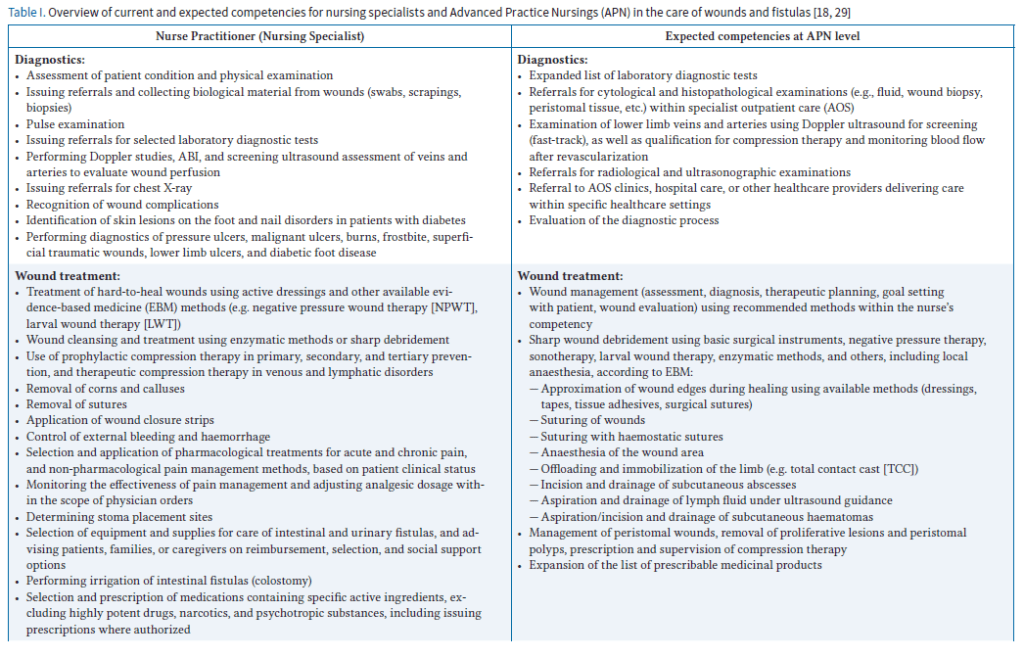
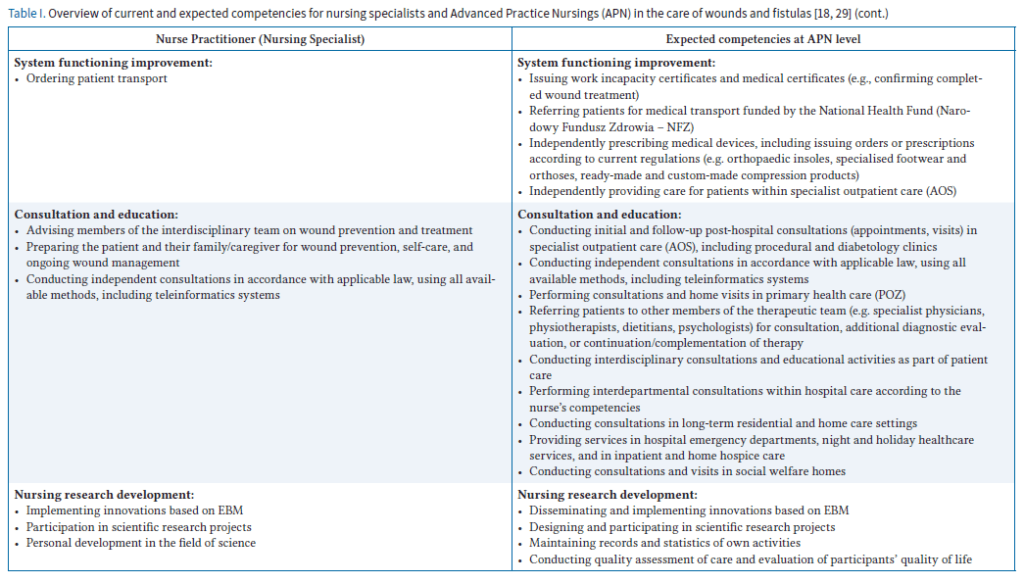
The implementation of APN in Poland requires adaptation of the legal framework to formally recognise this professional pathway with a defined scope of competencies, as well as to establish legal provisions for the implementation and reimbursement of healthcare services. It is recommended that standards be developed for clinical education and APN certification, including requirements for practice and broader authorisations to perform diagnostic and therapeutic tasks. Table I summarises the expected competencies associated with the development of advanced practice.
Discussion
Advanced Practice Nursing represents a desirable career pathway for nurses in Poland and should be developed on a solid foundation within the national healthcare system, drawing on the example of leading international nursing leaders. Standardisation and the type of certification remain subjects of ongoing discussion, requiring both professional approval and legal and systemic legitimisation. Effective implementation of APN necessitates consensus among nursing leaders, updates to normative legal acts, clear definition of the roles of nurses, specialist nurses, and APN, allocation of funding, reforms in postgraduate education, and the establishment of pilot programs to evaluate and support the professional development trajectory. Experts from the Polish Wound Treatment Society recommend systemic changes regarding nursing practice and APN, with particular emphasis on wound prevention and treatment. It is recognised that the implementation of APN could successfully begin in the clinical area of wound prevention and management, providing tangible benefits for the growing population of patients with chronic wounds of various aetiologies, across primary care, specialist outpatient care, long-term care, and palliative care settings. The implementation of APN in wound prevention and management is essential for improving the functioning of the healthcare system in Poland. Dynamic demographic and epidemiological changes necessitate the introduction of innovative healthcare delivery models that make better use of the potential of nurses. Advanced Practice Nursing provides a practical response to contemporary health challenges, enabling more efficient, accessible, and patient-centred care. It expands professional opportunities and allows nurses to perform more advanced clinical functions, contributing to improved accessibility, quality, and effectiveness of care. It is advocated that every effort be made to strengthen specialist nursing practice and to advance the definition of the taxonomy and legislation for advanced professional practice in Poland. Numerous international studies indicate that services provided by highly qualified nurses are safe for patients and improve patient satisfaction with care. Systemic economic benefits have also been identified, including cost-effectiveness analyses [18, 19]. Ensuring continuity of care without the need to wait for a physician’s appointment, as well as increasing nurse accessibility, enhances system functionality. Demonstrated benefits also include a reduction in mortality among patients with chronic diseases and higher levels of patient satisfaction with the care received [30, 31]. Strengthening the healthcare system is supported through autonomous specialist practice, interdisciplinary collaboration, and the consultation and education of patients and their close family members. High-level competencies and clinical skills contribute to cost reduction, increased accessibility of care, and improvement of patient quality of life and well-being across various healthcare settings. By expanding the scope of practice, APN ultimately provides benefits not only to patients but also to the broader healthcare system [32].
Conclusions
The implementation of APN in wound prevention and management is essential for improving the performance of the healthcare system in Poland. Dynamic demographic and epidemiological changes necessitate the introduction of innovative healthcare delivery models that make better use of nurses’ potential. Advanced Practice Nursing provides a practical response to contemporary health challenges, enabling more efficient, accessible, and patient-centred care. It expands professional opportunities and allows nurses to assume more advanced clinical roles, contributing to improved accessibility, quality, and effectiveness of care.
Disclosures
The authors declare no conflict of interest. This paper did not receive external funding. Approval of the Bioethics Committee was not required.
References
- Schober M. Development of advanced practice nursing: The international context. Enferm Clin (Engl Ed) 2019; 29: 63–66. DOI: 10.1016/j.enfcli.2018.08.002.
- Schober M. Introduction to Advanced Practice Nursing. Springer, Cham 2016.
- Bryant-Lukosius D, Wong FKY. International development of advanced practice nursing. In: Tracy MF, O’Grady ET (eds.). Advanced Practice Nursing: An Integrative Approach, 6th ed. Elsevier 2019; 129–141.
- Harris JL. Turning health policy into practice. In: Goudreau KA, Smolenski MC (eds.). Health Policy and Advanced Practice Nursing, 3rd ed. Springer Publishing Company LLC 2023; 3–11.
- World Health Organization European Region. Technical Brief on Strengthening the Nursing and Midwifery Workforce to Improve Health Outcomes: What is Known About Advancing Roles for Nurses – Evidence and Lessons for Implementation. WHO Regional Office for Europe, Copenhagen 2023.
- World Health Organization. State of the World’s Nursing 2025: Investing in Education, Jobs, Leadership and Service Delivery. WHO, Geneva 2025.
- International Council of Nurses. Nursing and Primary Health Care: Towards the Realization of Universal Health Care. A Discussion Paper. ICN, Geneva 2024.
- Delamaire M, LaFortune G. Nurses in Advanced Roles: A Description and Evaluation of Experiences in 12 Developed Countries. OECD; 2010. DOI: 10.1787/18152015.
- State of the World’s Nursing – Report 2020: Investing in Education, Jobs and Leadership. World Health Organization; 2020 (electronic version); International Council of Nurses. The Scope of Practice, Standards and Competencies of the Advanced Practice Nursing. ICN Regulation Series. ICN, Geneva 2008.
- Cooper MA, McDowell J, Raeside L; APN–CNS Group. The similarities and differences between advanced nurse practitioners and clinical nurse specialists. Br J Nurs 2019; 28: 1308–1314. DOI: 10.12968/bjon.2019.28.20.1308.
- Barton D, East L. The evolution of advanced nursing practice. In: Barton DT, Allan D (eds.). Advanced Practice Nursing: Change in a Changing World. Palgrave Macmillan 2015; 1–20.
- International Council of Nurses (ICN). Definition and characteristics of the role. 2002. Retrieved February 19, 2016. Available at: http://www.icn-apnetwork.org (Access: 2.02.2026).
- Wheeler KJ, Miller M, Pulcini J, Gray D, Ladd E, Rayens MK. Advanced Practice Nursing Roles, Regulation, Education, and Practice: A Global Study. Ann Glob Health 2022; 88: 42. DOI: 10.5334/aogh.3698.
- Pulcini J, Jelic M, Gul R, Loke AY. An international survey on advanced practice nursing education, practice, and regulation. J Nurs Scholarsh 2010; 42: 31–39. DOI: 10.1111/j.1547-5069.2009.01322.x.
- Sastre-Fullana P, De Pedro-Gómez JE, Bennasar-Veny M, Serrano-Gallardo P, Morales-Asencio JM. Competency frameworks for advanced practice nursing: a literature review. Int Nurs Rev 2014; 61: 534–542. DOI: 10.1111/inr.12132.
- International Council of Nurses. ICN Nursing Care Continuum and Competences. ICN, Geneva 2008.
- Directive 2013/55/EU of the European Parliament and of the Council of 20 November 2013 amending Directive 2005/36/EC on the recognition of professional qualifications and Regulation (EU) No 1024/2012 on administrative cooperation through the Internal Market Information System. Official Journal of the European Union L354/132; 28 December 2013.
- Rozporządzenie Ministra Nauki z dnia 10 października 2024 r. zmieniające rozporządzenie w sprawie standardów kształcenia przygotowującego do wykonywania zawodu lekarza, lekarza dentysty, farmaceuty, pielęgniarki, położnej, diagnosty laboratoryjnego, fizjoterapeuty i ratownika medycznego. Dz. U. 2024, poz. 1514.
- Ustawa z dnia 15 lipca 2011 r. o zawodach pielęgniarki i położnej (t.j. Dz.U. 2020, poz. 562 ze zm.). Available at: https://api.sejm.gov.pl/eli/acts/DU/2020/562/text.pdf (Access: 25.12.2025).
- Rozporządzenie Ministra Zdrowia z dnia 28 lutego 2017 r. w sprawie rodzaju i zakresu świadczeń zapobiegawczych, diagnostycznych, leczniczych i rehabilitacyjnych udzielanych przez pielęgniarkę albo położną samodzielnie bez zlecenia lekarskiego. Dz. U. 2017, poz. 497. Available at: https://isap.sejm.gov.pl/isap.nsf/download.xsp/WDU20170000497/O/D20170497.pdf (Access: 25.12.2025).
- Harpula K, Bartosiewicz A, Krukowski J. Polish Nurses’ Opinions on the Expansion of Their Competences-Cross-Sectional Study. Nurs Rep 2021; 11: 301–310. DOI: 10.3390/nursrep11020029.
- Rozporządzenie Ministra Zdrowia z dnia 23 września 2019 r. zmieniające rozporządzenie dotyczące gwarantowanych usług w zakresie ambulatoryjnej opieki specjalistycznej. Dz. U. 2019, poz. 1864. Available at: https://isap.sejm.gov.pl/isap.nsf/download.xsp/WDU20190001864/O/D20191864.pdf (Access: 3.01.2026).
- Rozporządzenie Ministra Zdrowia z dnia 8 lipca 2020 r. zmieniające rozporządzenie dotyczące gwarantowanych świadczeń w dziedzinie podstawowej opieki zdrowotnej. Dz. U. 2020, poz. 1225. Available at: https://isap.sejm.gov.pl/isap.nsf/download.xsp/WDU20200001255/O/D20201255.pdf (Access: 3.01.2026).
- Jarzynkowski P, Piotrkowska R, Książek J. Nursing education systems in selected European countries and the United States. Nurs Probl 2015; 23: 117–122.
- Bazaliński D, Banasiewicz T (eds.). Rany w praktyce lekarza i pielęgniarki podstawowej opieki zdrowotnej. Medical Tribune Polska, Warsaw 2025.
- Probst S, Apelqvist J, Bjarnsholt T, et al. Antimicrobials and non-healing wounds: An update. J Wound Manag 2022; 23(3 Suppl 1): S1–S33.
- Sopata M, Jawień A, Mrozikiewicz-Rakowska B, et al. Wytyczne postępowania miejscowego w ranach niezakażonych, zagrożonych infekcją oraz zakażonych – przegląd dostępnych substancji przeciwdrobnoustrojowych stosowanych w leczeniu ran. Zalecenia Polskiego Towarzystwa Leczenia Ran. Leczenie Ran 2020; 17: 1–21. DOI: 10.5114/lr.2020.96820.
- Corbett LQ. Wound Care Nursing: Professional Issues and Opportunities. Adv Wound Care (New Rochelle) 2012; 1: 189–193. DOI: 10.1089/wound.2011.0329.
- Wieczorek-Wójcik B, Kowalska K, Leyk-Kolańczak M, et al. Działania na rzecz rozwoju pielęgniarki zaawansowanej praktyki w Polsce – projekt pilotażu APN w zakresie leczenia ran i przetok. Leczenie Ran 2024; 21: 92–97. DOI: 10.60075/lr.v21i3.77.
- Laurant M, van der Biezen M, Wijers N, Watananirun K, Kontopantelis E, van Vught AJ. Nurses as substitutes for doctors in primary care. Cochrane Database Syst Rev 2018; 7: CD001271. DOI: 10.1002/14651858.CD001271.pub3.
- Aiken LH, Sloane D, Griffiths P, et al.; RN4CAST Consortium. Nursing skill mix in European hospitals: cross-sectional study of the association with mortality, patient ratings, and quality of care. BMJ Qual Saf 2017; 26: 559–568. DOI: 10.1136/bmjqs-2016-005567.
- Wilson DM, Murphy J, Nam MA, Fahy A, Tella S. Nurse and midwifery prescribing in Ireland: A scope-of-practice development for worldwide consideration. Nurs Health Sci 2018; 20: 264–270. DOI: 10.1111/nhs.12408.