

Review paper | Artykuł przeglądowy
The use of virtual reality in treating chronic wounds. A review of the available literature
Julia Bryła  1, Julia Dzień 1, Anna Surmacz 2,3,4, Dariusz Bazaliński 2
1 Student Scientific Circle of Elderly Care, Institute of Nursing, Faculty of Health Sciences and Psychology, Collegium Medicum, University of Rzeszow, Poland
2 Specialist Hospital, Podkarpackie Oncology Center of Fr. B. Markiewicz in Brzozow, Poland
3 Institute of Nursing, Faculty of Health Sciences and Psychology, Collegium Medicum, University of Rzeszow, Poland
4 University Center for Research and Development in Health Sciences, Rzeszow, Poland
Address for correspondence:
Julia Bryła, Student Scientific Circle of Elderly Care, Institute of Nursing, Faculty of Health Sciences and Psychology, Collegium Medicum, University of Rzeszow, 35-959 Rzeszow, Poland, e-mail: jb130749@stud.ur.edu.pl
Received: 15.12.2025 Accepted: 19.01.2026
LECZENIE RAN 2025; 22 (4): 163–168
DOI: https://doi.org/10.60075/lr.v22i4.128 Artykuł (PDF)
Table of contents:
Abstract
Introduction
Aim of the study
Material and methods
Results
Discussion
Conclusions
Disclosures
References
Abstract
Introduction: The pain that patients experience while their wounds are being cleaned is a serious problem that is often underestimated. The occurrence of pain during debridement can have a negative impact on patients’ quality of life and may lead them to hesitate to undergo the procedure. The use of virtual reality (VR) can reduce pain. This technology distracts the patient from the uncomfortable medical procedure, which can lead to improved comfort during wound treatment and a reduction in unpleasant sensations.
Aim of the study: The study aimed to analyse the literature on non-pharmacological methods of reducing pain during wound debridement using VR.
Material and methods: The following databases were reviewed: PubMed, Springer, CINAHL and EBSCO. The following keywords were used in the search process: “virtual reality”, “pain”, and “wound”. The literature search was restricted to manuscripts published between 2016 and 2025. A total of 484 records were identified and, after removing 24 duplicates, 460 articles were selected for preliminary analysis. A total of 320 studies were excluded based on their titles and abstracts. Seven studies on wound treatment procedures in adults were included. The selection process took place in two stages: first, the titles and abstracts were analysed, and then the full texts were examined.
Results: A review of the literature on randomised and observational studies reveals that VR is effective in reducing perceived procedural pain (p < 0.05). The analysis also indicates a reduction in anxiety levels before and during the procedure. A reduction in perceived pain was shown in five studies, and a reduction in perceived anxiety was shown in one study. VR was highly effective when used with a group of adults with chronic wounds, including venous ulcers, and during short surgical procedures and wound suturing.
Conclusions: Virtual reality is a safe method of reducing perceived pain during short procedures. It improves patients’ well-being and how they perceive pain, which may reduce the need for pharmacotherapy. However, further research is required to confirm these results and establish the ideal conditions for the clinical application of VR.
Key words: virtual reality, pain, wound treatment, wound debridement, non-pharmacological methods, dressing change, fear.
Introduction
Virtual reality (VR) is a technology that allows the user to immerse themselves in a digital, three-dimensional environment. This phenomenon is referred to as immersion, i.e. the feeling of actually being in a virtual space. The utilisation of VR goggles primarily engages the senses of sight and hearing, thereby effectively diverting attention from external stimuli and potentially mitigating pain perception [1–3]. In recent years, this method has gained increasing importance in the management of pain of various etiologies, and it has been positively reviewed in terms of its use in clinical practice. Its merits in the fields of medicine and health sciences are well-documented, and its utilisation in educational settings and clinical nursing practice is growing [4, 5].
In the field of psychology, distraction is defined as a mechanism for diverting attention away from undesired stimuli. These stimuli have been shown to disrupt attention and can take various forms, such as VR and associated emotional responses [6, 7].
Unpleasant pain sensations frequently accompany treatment protocols related to wound debridement and dressing. Even though the procedure is brief, it poses a clinical challenge due to fears and anxiety about debridement [8, 9]. In cases of severe pain, the patient’s cooperation with medical staff can be hindered, resulting in delays to the procedure and affecting the healing process [10]. Prolonged pain after the intervention has the potential to impede the patient’s daily functioning, negatively affect their mood, and may even compromise the quality of their sleep. In the treatment of acute pain, a combination of pharmacological and non-pharmacological methods is frequently implemented. The utilisation of VR technology, as shown by its beneficial effects on pain management and its favourable patient reception, presents a promising alternative for medical procedures involving basic wound treatment [11].
The potential benefits of using VR during medical procedures related to wound debridement include distraction by reducing patient tension, which translates into pain reduction.
Aim of the study
The aim of the study was to evaluate the effectiveness of VR as a non-pharmacological method of reducing anxiety and pain during wound debridement and dressing changes in patients.
Material and methods
A comprehensive literature review was conducted in accordance with the PRISMA 2020 and PICOS framework (Population, Intervention, Comparison, Outcome, and Study design). This approach allowed us to systematically define the research question and ensure a transparent selection process. By specifying these key components, we established precise boundaries for the study and minimized potential. The following bibliographic databases were to be consulted: PubMed, Springer, CINAHL and EBSCO. The analysis was conducted from 1 February to 30 June 2025. The following key words were utilised in the search process: “virtual reality”, “pain”, and “wound”. The scope of the database searches was limited to manuscripts published between 2016 and 2025.
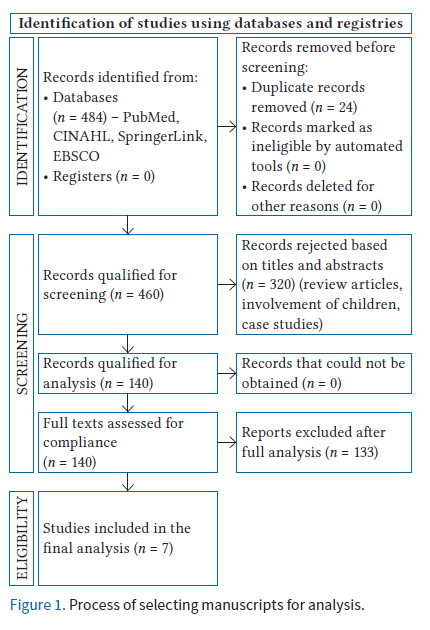
A total of 484 manuscripts were identified, with 24 of these being duplicates. Initially, 460 works were qualified for analysis. Of the documents analysed, 320 works were rejected on the basis of abstracts and titles not meeting the review criteria, including review articles, studies on children, and case studies (Fig. 1). In accordance with the established methodological criteria, a total of 133 publications were excluded from the review, resulting in a final analysis of seven studies (see Table I) that involved adult patients undergoing wound treatment procedures. The selection process was conducted in two stages. Initially, studies were selected based on their title and abstract. In the subsequent stage, the full texts were analysed to determine final qualification. The review was conducted manually, and the selection and preliminary review were supervised by a team member responsible for the quality selection of manuscripts. The selection process was carried out independently by two members of the research team.
Results
Analysis of the available literature showed that, of the seven studies included in the final review, most indicated a statistically significant reduction in procedural pain intensity when VR was used compared to standard care (usually a reduction of 1.3–3 points on the VAS/NRS scale) [11–17]. The authors of one study demonstrated that using VR reduces peri-procedural anxiety [12]. Specific data are presented in Table I.
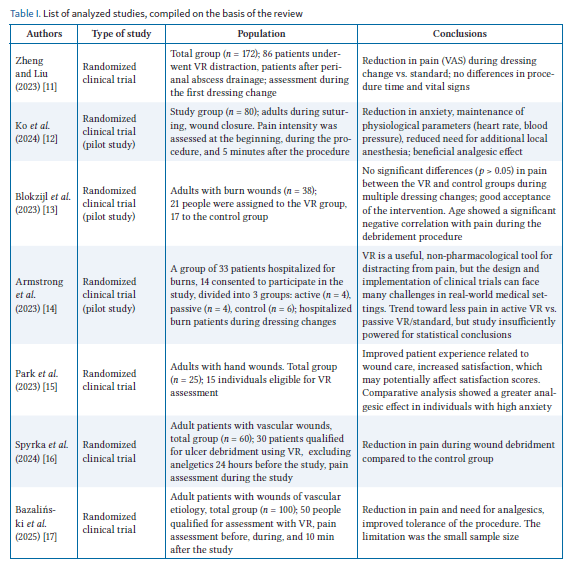
The results also revealed interesting findings regarding a significant improvement in patient cooperation with medical staff and better tolerance of procedures [11, 12, 14–17]. Two studies showed that VR reduced the duration of the procedure [12, 15]. One study did not confirm statistical differences between the VR and control groups; however, the authors note in the limitations section that the sample size was too small and the wounds were too specific [13]. As the literature review indicates, VR technology can positively impact the need for pharmacotherapy during surgery, potentially eliminating it entirely [16, 17].
Although the results are promising, the following limitations of these studies should be taken into account when interpreting them:
- small sample sizes in most studies (with the exception of Zheng 2023 [11], which had 172 participants), which limits the statistical power and generalisability of the results;
- heterogeneity of VR interventions (e.g. different content and exposure time, active versus passive VR), and a lack of standardisation of protocols;
- diversity of study populations and locations of procedures (e.g. hospital, clinic or outpatient care), as the environment in which the procedure is performed may influence the effect of the intervention;
- mixed nature of studies;
- predominance of subjective outcomes (e.g. VAS/NRS scales, MPQ and self-rated anxiety), with limited objective measures (e.g. medication use and procedure time), and rare long-term measurements of VR effects (only some studies analysed long-term follow-up).
The authors of the analysed studies unanimously postulated the need for studies on larger and more diverse populations, including randomised controlled trials (RCTs) with adequate power. They also recommended standardising VR content and exposure time, as well as introducing objective measures of effect, such as quantitative data on analgesics, procedure duration and tolerance indicators. The necessity for long-term effect assessments and subgroup analyses (e.g., wound type, age, gender) was also emphasised.
In the context of population and environmental factors, it is worth noting that the location of the procedure (e.g., hospital ward, outpatient clinic or home care) and staff training may influence the effectiveness of VR, and these factors should be controlled for in future studies. Some types of wounds (e.g., venous ulcers and ischaemic wounds) may have different pain profiles and require different therapeutic strategies. In the analysed studies, research into venous ulcers [16] and wounds with an angiopathic aetiology (venous, non-ischaemic, and in the course of diabetes) [17] is still limited and requires in-depth research and observation.
Gender differences in pain perception need to be considered in future studies. The available literature suggests that there are differences between women and men [16]. These differences should be analysed in future in studies with adequate subgroups.
While the elderly population (aged 60+ years) generally tolerated VR well, some individuals required a short adaptation period due to dizziness and cybersickness. It is necessary to monitor and adjust exposure time for elderly individuals.
Discussion
This review includes seven randomized trials of non-pharmacological pain therapies for dressing changes to wounds of various origins in adults. The review indicates that VR is a safe method of reducing pain by distracting patients during short wound care procedures.
Dressing changes and wound interventions can cause pain, and the sight of the wound and blood can be an additional stressor for sensitive individuals. Therefore, effective pain management is an important part of treatment in both the healing and care of postoperative wounds and chronic wounds associated with vascular angiopathy [18]. According to Gardner et al. [19], 74% of patients report moderate to severe pain during dressing changes, and approximately 36% of respondents experience severe pain.
The pain component can be complex and result from visual perception associated with activities performed inside the wound. Iatrogenic pain is associated with insensitivity, inappropriate instruments, or dressings used during the procedure. Slowing of the wound healing process and reduced quality of life for the patient are common observations by authors [20]. Wound-related pain can have various components (somatic, neurogenic, and psychological) resulting from tissue ischemia, nerve damage, inflammation caused by infection, as well as helplessness and limited ability to perform social and family roles [16]. Pain management during minor surgical procedures in the treatment of wounds of various etiologies is often underestimated in everyday clinical practice [17]. Pharmacotherapy remains the most effective and efficient method of pain reduction. However, growing concerns about the side effects of traditional analgesics and disturbing psychosomatic experiences highlight the need for innovative non-pharmacological management strategies [19].
A review has shown that the use of VR technology has reduced procedural pain [11, 12, 14–17] and anxiety/fear associated with wound care/dressing changes [12]. The use of goggles also reduced the need for local anesthesia or pain medication [12, 16, 17] and improved overall tolerance/acceptance of the procedure [12, 13, 16].
The results suggest that the use of VR goggles may be an effective non-pharmacological and non-invasive supportive method. The analysis indicates that the possibilities associated with non-pharmacological pain relief in a group of patients with chronic wounds are promising in terms of improving the patient’s perception of therapy [12, 13, 16, 17] and actually reducing the pain experienced [11–17].
One limitation is the diversity of VR applications (passive and active forms) and the lack of standardization of protocols, which makes it difficult to generalize the results. The available evidence comes mainly from studies with a small number of participants, and not all of them reported complete data on analgesics or anxiety levels, which requires caution in interpretation.
The results of the review are consistent with previous observations from reviews conducted by Demirci et al. [21] and Mazaheri et al. [22] who indicate a reduction in perceived pain and an improvement in the overall acceptance of dressing change or wound debridement procedures.
Future studies should standardize VR protocols (specifying the type of session, duration of the experience, presence of auditory stimuli, timing of use during the procedure) and control and measure the actual impact on the use of analgesics/local anesthetics, as data on the actual reduction in medication use are inconclusive and incomplete. Future studies should specify subgroup analysis (age, gender, origin), concluding which groups benefit most from the use of VR technology.
It is difficult to perform a reliable analysis given the heterogeneous data on pain associated with dressing changes, the wide age range of the study population, the variety of outcome assessment tools, and the small number of interventions. There is no consensus on the mechanisms by which VR alleviates pain responses. The hardware and software used in VR interventions vary across studies, and questions about the durability of effects and potential mechanisms of action require further investigation. Despite these limitations, the studies analyzed show a trend toward pain reduction and improved patient comfort, suggesting that VR has great potential as a non-pharmacological adjunct to standard pain management methods in the care of patients with wounds.
Considering the portability of modern VR devices, the greatest potential for implementation lies in outpatient clinics and home settings, where multimodal pain management is often resource-limited. VR technology is becoming a scalable solution for various clinical settings.
Conclusions
Virtual reality is a safe method of supporting pain management during short procedures. It improves the patient’s well-being and pain perception, which may contribute to reducing the use of pharmacotherapy. However, more extensive research is needed to confirm the current results and determine the optimal conditions for the clinical application of VR.
Disclosures
The authors declare no conflict of interest.
The project was funded by the state budget, granted by the Polish Minister of Science and Higher Education as part of the “Studenckie koła naukowe tworzą innowacje” (Student Research Clubs Create Innovations) program, 2024, project no. SKN/SP/602404.
Approval of the Bioethics Committee was not required.
References
- Gur EY, Apay SE. The effect of cognitive behavioral techniques using virtual reality on birth pain: a randomized controlled trial. Midwifery 2020; 91: 102856. DOI: 10.1016/j.midw.2020.102856.
- Luo H, Cao C, Zhong J, Chen J, Cen Y. Adjunctive virtual reality for procedural pain management of burn patients during dressing change or physical therapy: A systematic review and meta-analysis of randomized controlled trials. Wound Repair Regen 2019; 27: 90–101. DOI: 10.1111/wrr.1.
- Demirci H, Lachkar T, Fleur WXI, Barsom EZ, Eskes AM, Schijven MP. The effect of virtual reality therapy on pain and anxiety during wound care in adults: A systematic review. Heliyon 2024; 10: e40858. DOI: 10.1016/j.heliyon.2024.e40858.
- Osumi M, Inomata K, Inoue Y, Otake Y, Morioka S, Sumitani M. Characteristics of Phantom Limb Pain Alleviated with Virtual Reality Rehabilitation. Pain Med 2019; 20: 1038–1046. DOI: 10.1093/pm/pny269.
- Ma Y, Li Y, Wang C, et al. Effects of non-pharmacological interventions on pain in wound patients during dressing change: A systematic review. Nurs Open 2024; 11: e2107. DOI: 10.1002/nop2.2107.
- Meyerbröker K. Virtual reality in clinical practice. Clin Psychol Psychother 2021; 28: 463–465. DOI: 10.1002/cpp.2616.
- Rodriguez ST, Jimenez RT, Wang EY, et al. Virtual reality improves pain threshold and recall in healthy adults: A randomized, crossover study. J Clin Anesth 2025; 103: 111816. DOI: 10.1016/j.jclinane.2025.111816.
- Guo C, Deng H, Yang J. Effect of virtual reality distraction on pain among patients with hand injury undergoing dressing change. J Clin Nurs 2015; 24: 115–120. DOI: 10.1111/jocn.12626.
- McCaughan D, Sheard L, Cullum N, Dumville J, Chetter I. Patients’ perceptions and experiences of living with a surgical wound healing by secondary intention: a qualitative study. Int J Nurs Stud 2018; 77: 29–38. DOI: 10.1016/j.ijnurstu.2017.09.015.
- Kim JY, Kim NK, Lee YJ. A descriptive study of Korean nurses’ perception of pain and skin tearing at dressing change. Int Wound J 2016; 13 Suppl 1 (Suppl 1): 47–51. DOI: 10.1111/iwj.12539.
- Zheng L, Liu H. Virtual reality distraction, a novel tool for pain alleviation during dressing change following surgical drainage of perianal abscess at Day Treatment Centre. Digit Health. 2023; 9: 20552076231155675. DOI: 10.1177/20552076231155675.
- Ko SY, Wong EM, Ngan TL, et al. Effects of virtual reality on anxiety and pain in adult patients undergoing wound-closure procedures: A pilot randomized controlled trial. Digit Health 2024; 10: 20552076241250157. DOI: 10.1177/20552076241250157.
- Blokzijl SJ, Lamberts KF, Nieuwenhuis MK, Beerthuizen GIJM, Spikman JM. Virtual Reality as Pain Relief in Burn Care: A Pilot Randomized Controlled Trial on the Effectiveness on Pain During Multiple Dressing Changes. J Burn Care Res 2023; 44: 1125–1133. DOI: 10.1093/jbcr/irad039.
- Armstrong M, Coffey R, Luna J, Xiang H. Pilot randomized clinical trial of virtual reality pain management during adult burn dressing changes: Lessons learned. PLOS Digit Health 2023; 2: e0000231. DOI: 10.1371/journal.pdig.0000231.
- Park SK, Oakes TC, Lin JC, Chahal R, Clarkson JHW. A Comparison between the Use of Patient-worn Virtual Reality in Wound Care and Hand Surgery: How Does Virtual Reality Work? Plast Reconstr Surg Glob Open 2023; 11: e5185. DOI: 10.1097/GOX.0000000000005185.
- Spyrka K, Rojczyk E, Brela J, Sieroń A, Kucharzewski M. Virtual reality as a promising method of pain relief in patients with venous leg ulcers. Int Wound J 2024; 21: e70082. DOI: 10.1111/iwj.70082.
- Bazaliński D, Wójcik A, Pytlak K, et al. The Use of Virtual Reality as a Non-Pharmacological Approach for Pain Reduction During the Debridement and Dressing of Hard-to-Heal Wounds. J Clin Med 2025; 14: 4229. DOI: 10.3390/jcm14124229.
- Goto T, Saligan LN. Wound pain and wound healing biomarkers from wound exudate: A scoping review. J Wound Ostomy Continence Nurs 2020; 47: 559–568. DOI: 10.1097/WON.0000000000000703.
- Gardner SE, Blodgett NP, Hillis SL, et al. HI-TENS reduces moderate-to-severe pain associated with most wound care procedures: a pilot study. Biol Res Nurs 2014; 16: 310–319. DOI: 10.1177/1099800413498639.
- Çetinkaya Özdemir S, Stolt M. The effect of virtual reality on patients’ experiences of pain during painful wound care procedure: a systematic review and meta-analysis of randomized controlled trials. BMC Nurs 2025; 24: 1346. DOI: 10.1186/s12912-025-03984-z.
- Demirci H, Lachkar T, Fleur WXI, Barsom EZ, Eskes AM, Schijven MP. The effect of virtual reality therapy on pain and anxiety during wound care in adults: A systematic review. Heliyon 2024; 10: e40858. DOI: 10.1016/j.heliyon.2024.e40858.
- Mazaheri M, Crooijmans RF, Vereen M, Corten EML. Clinical efficacy and patients’ perception of virtual reality during wound care in adults: A systematic review with meta-analysis of randomised clinical trials. Wound Repair Regen 2023; 31: 764–778. DOI: 10.1111/wrr.13128.